
CBG Supply chain: Learnings from a parallel world
Uncanny similarities in supply chain of Milk and Compressed Biogas (CBG)
1/13/20262 min read
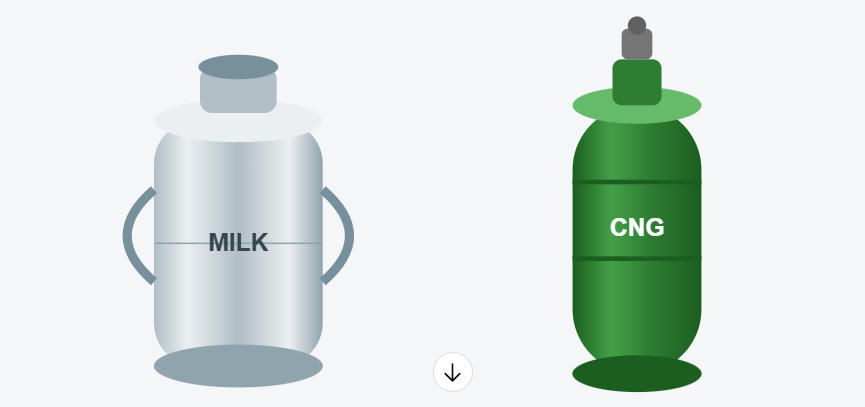
One might be wondering what on earth could be the link between Milk and Compressed biogas. One is a food product consumable the other is a vehicle fuel. Let’s deep dive to see what cues we can take from Milk supply chain to manage CBG logistics and why it becomes crucial as we scale up the CBG infrastructure in the country over the next few years.
Milk supply chain in India has evolved over the years along with the cooperative movement. The farmer to retail outlet supply chain is one of the most complex and time sensitive supply chain operations. The total turnaround time from the milk collection point to the outlet is 24-36 hours. This includes collection, processing, chilling, storage and transportation. The stringent requirement of freshness by the consumer at the time of purchase drives the tightness of the milk supply chain. Historically, in the eastern cultures Milk has been consumed within a span of 6-18 hours from the time of production. This is the primary driver that requires the supply chain to deliver fresh milk to the consumer within such short span of time.
When it comes to Compressed Biogas transportation there is an uncanny similarity. The gas hence produced has to be transported to the nearest consumption point within hours of production. Though there is no perishability factor here the gas storage is Capital intensive. Higher capacities demand higher capital investment. Every cubic meter of storage roughly costs about INR 1600-2000. Even after high levels of compressions (200-250 bar) the gas continues to be in gaseous state and does not liquify. CBG and Natural gas behaves differently as compared to fuels like LPG (liquified petroleum natural gas). 1 Liter of LPG in liquid state converts to about 270 liters in gaseous state. But in case of CBG/Natural gas even after liquefaction the compression ratio is about 2.2 only. This is the primary factor that makes the Natural gas supply chain complex.
CBG logistics is a fine balancing act between two situations of flaring at site and stock outs at the retail outlet. Lack of adequate storage at the production site leads to flaring at site. At the same time lack of timely replenishment at the gas station leads to stock out situation.
What cues can we take from Milk supply chain and incorporate to CBG logistics.
1. Time sensitive movements – Turn around times of the vehicles is a crucial aspect. Loading, driving, unloading, administrative times are all to be accounted for to achieve accurate replenishments.
2. Building adequate redundancy – Building redundant infrastructure(vehicles, cascades) will be crucial to ensure there are very few instances of imbalances in supply chain.
3. Visibility to downstream supply chain – Continued visibility to downstream consumption patterns and preventive maintenance activities etc. helps manage the supply scenarios efficiently on a daily basis
These kinds of adaptations not only help in the performance improvement of the CBG plants but also as India moves towards building 5000 CBG plants and march towards Net Zero goals such adaptations of logistics planning and execution becomes absolutely crucial and necessary.